Twilight of the Brands?
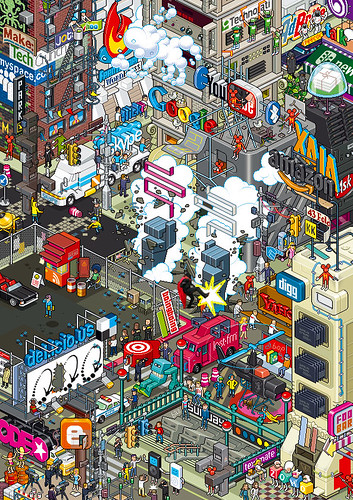
eBoy and Usability Man's Web2.0 brand mashup (Craig Grobler / Flickr)
Media organizations are still grappling with the fact that on the Web, a page is only a tiny, tiny hyperlink away from any other. We’ve spent years trying to obfuscate this fact, at first refusing to “link out” beyond our artificial domain-spaces, then opening these “outside” links in new windows, building up elaborate schemes to suggest that these domain-spaces really are entirely separate places, that moving from one site to another really does require travel. As our media begin to disintegrate into their component parts – newspapers fragmenting into stories dissipating into excerpts breaking down, at last, into data – the last great refuge of the coherent, bundled mediascape of yesteryear has become the brand. Brand power – brand equities, brand identities, brand loyalties – will keep us relevant even after fragments of our content stand alone in the Webby wilderness, we’ve believed.
But what if it’s not true? What if the concept of “the brand” – which really kicked into high gear as the industrial era hit its stride – is eroding or devolving as well? Where would that leave us? What might it enable?
There’s some evidence that we hit Peak Brand long ago. Brands seem to have been reduced to products, becoming commoditized and generic. As easy as it’s become to “launch” a new one (Glenn Beck’s “The Blaze” seemed to explode out of the ether this month), it’s even easier to forget the dozens that seem to launch every moment (one year ago today, Mediagazer was heralding the launch of Fox’s mobile Hulu-killer, “Bitbop” – anyone remember that one?).
Today you can launch your media company and call it “TBD,” and folks will just shrug or chuckle. A year from now, some genius will launch a hot new media property called “Whatevs.” It’s only a matter of time until someone starts to go to all the trouble of launching a brand, and then realizes what they really need is a hashtag.
This matters because to us media folks, brands are still key to how we organize the digital universe in our heads, and it’s not at all clear that users think the same way. When we’ve started talking about Twitter “breaking” stories or users finding stories on Facebook, it underscores how porous the concept of a brand has become. Can we imagine a way to thrive in a universe where our brands might be invisible?
It also matters because concern for brand integrity can make us excessively risk-averse at a time when experimentation is vital. We’re in constant danger of designing media experiences that serve our brands first, our content second, and our users last. If every digital experience was crafted in isolation, freed from brand constraints, what would we be able to do? If we designed every page, every popup, and every app by asking how the brand might serve the user experience rather than vice-versa, where would that lead us?
Even if all of the above is true, brands aren’t going anywhere. AOL, among others, is doubling down on a brand-driven strategy. So we also have to imagine our roles as media organizations and media individuals in a world where brands only become bigger and more important, where in many users’ minds, our orgs are just “micro-brands” feeding the “umbrella brands” of Twitter/Facebook/Google/Bitbop/etc.
All these questions and suppositions are just teasers. For the real exploration of these ideas, you’ll have to vote for (and then attend) the session I’m hoping to lead with Megan Garber at this year’s Online News Association conference: “The Brand Is Dead, Long Live the Brand!” I promise great fun, tweetable nuggets of insight, and some rollicking surprises.

TV news is the indicator for how news brands function in over-populated systems: individual personalities paired with overall (“umbrella”) station brand does better with brand metrics than just mastheads and header images.
How else could a DMA like the Twin Cities still support *four* channels doing nightly newscasts at the same times with almost the exact same content? People like their news from subtly different personalities (with or without the news).
Successful digital outlets are learning and have started picking up their own personalities to fold into their overall news brands — Nate Silver to the Times, Frank Rich to the Daily Beast, Brietbart (unfortunately) to the HuffPo, Sullivan on the move, etc.
Taylor
25 Mar 11 at 1:40 pm
This is an intriguing subject, and I’m sure you guys will give it a nuanced examination. It needs that. Like the department store that sold kitchen appliances and underwear, the umbrella news brand certainly is being (has been) disintermediated.
A caution: Your brief intro here seems to conflate “brand” with “package,” a limitation that would severely restrict its usefulness.
Brand is equally (or likely more) concerned with reputation, which is another matter altogether. Bitbop, TBD, Whatevs and the like seem to me a better illustration of the importance of brands than of their twilight.
Howard Weaver
26 Mar 11 at 5:08 pm
P.S. http://liten.be//xEwVP
Howard Weaver
26 Mar 11 at 5:44 pm